Showing posts with label classics. Show all posts

Friday, 4 January 2013

1001 Books Review: Parade's End


Let's carry on the 2013 reviews by featuring something I actually read in 2012. I know, I've been lazy. But there is just so much to this book that I'm daunted by the thought of trying to sum it all up. Here goes.

Parade's End has recently been a TV show starring Benedict Cumberbatch and his strangely motionless face, but, before that, it was a novel by Ford Madox Ford. In fact, it is four novellas packed into one enormous 800 page tome. About the effect of World War I on England in general, and about one hidebound bastion of English maleness in particular, Parade's End is the story of how Christopher Tietjens learned to shut up and be unfaithful to his wife already.

Tietjens presents himself as the last outpost of true English values, which he sees as being located firmly in the eighteenth century. This is brilliant in ways that Ford probably couldn't even predict, since these days we think of English values being eternally Victorian (or even Edwardian) - proving, if any more proof were needed, how nostalgia is permanently jumping backwards to the year before, and the year before that, and so on for ever. I bet the first Homo sapiens got nostalgic about being Australopithicae.

Anyway, Tietjens has a sulky and unfaithful wife called Sylvia who sort of hates him and sort of loves him and LONGS to divorce him - but he won't, because he believes in keeping up appearances (also known as parades, you see. There are a lot of different parades in this novel). Then Tietjens falls in love with a youthful suffragette called Valentine Wannop (a glorious name) and dooms them, because of his refusal to divorce his wife, to years of sexless super-British yearning. And then along comes WW1.

None of their faces ever move.
I'd read some Ford before - The Good Soldier, coincidentally also about miserable early twentieth-century marriage - so I was sort of expecting a more protracted version of that. But not at all. The Good Soldier is an Edwardian novel, albeit one with its petticoats over its head, but Parade's End is a fully-fledged modernist text, slightly mad and stark and with lashings of disconnected stream-of-consciousness confusion. Almost the whole thing is told as a series of flashbacks, which is very disconcerting. A character sits staring at a pot of flowers for ten straight pages, thinking about elephants and metaphysics and breasts, and then suddenly it's five years later and we're in France and the same character is huddling under a shell bombardment that sounds like metaphysical elephants dropping pans on each other's breasts. Or something.

I'm being facetious - really, I enjoyed this book. Sylvia, especially, is an astonishing character. She's so bad, but you understand and empathise with every step of that badness and with every nutty action it drives her to carry out. It's also got a lot of very smart things to say about gossip and reputation. So much mud is flung at Tietjens and the other characters during the novel and (I think this is a brilliant touch) not a single one of those rumours is true. Everyone is better, and more boring, than they are painted. Even Tietjens' brother Mark, who lives in sin with his mistress, has been faithful to her for twenty years and comes home every evening to the meat and potatoes she has cooked for his supper.

For a book that seems like it might be full of reactionary muttering about how bad change is, I was quite delighted by how balanced Ford is about the way that life - and the world - is constantly moving on. Christopher needs the parades he's so obsessed with to be over so he can finally free himself from mad Sylvia. His brother Mark, heir to an ancestral title he doesn't want, needs the world to change so he's not forced to manage a huge estate that he hates. Those that don't or won't change die - no, literally, they die - and what's left are those who are willing to alter and compromise. Thank god, Parade's End is a nostalgic novel that's not sentimental.

There are a lot of lovely things about Parade's End.  The relationship between Tietjens and Valentine is wonderful - they fall in love by having an argument about Latin translations, and the main reason why Tietjens fights through the war to get back to her is because he wants to spend the rest of his life talking to her about interesting ideas. The book itself, for all its convolutions and modernist clever-clever, is beautifully written and the characters are sympathetically drawn. This is not a novel to pick up lightly - seriously, it's got a heft like a brick - but it is one that deserves to be given the time it takes to read it. And, having read it, I can endorse the amazing BBC TV series even more fully than I did before.

4 stars.

Thursday, 3 January 2013

Review battle: ladies of the night edition

The two books I'm reviewing today complimented each other in ways I didn't even fully realise they would until after I'd finished the second. The connection I was originally going for, ignorant of all but their blurbs, was prostitutes. The protagonist of the first, after all, is a very successful one, and the action of the second centres around a home for (supposedly) reformed ones. But while the wholly expected pleasure of the first is its unrepentant, unlikely, idiotic naughtiness, its absolute commitment to the propagation of the myth of the happy and gloriously rapacious prostitute, the unexpected joy of the second is how it takes that expectation and kicks it straight in the face.

So, step into the ring Fanny Hill and The Unpierced Heart.

Fanny Hill by John Cleland

This is a novel on my 1001 Books list, and one with a history as eventful as its contents. First published in 1748 while its author languished in debtor's prison, it's been in trouble with the censors ever since. It's got a long and proud tradition of being only available in underground, bootleg editions, and it wasn't until the 1970s that it was available to purchase in legal and unexpurgated form. Essentially, the courts decided that while it was obscene, they'd seen obscener, and that it's also a pretty well-written book whatever its content. And I'd have to agree.

Rest assured: this book is erotica. Of course it is. Approximately half of the words in it are descriptions of genitals, and most of the rest are lavish descriptions of how those genitals are used. But it's also a lot of really charming fun. Fanny herself is a lively, lovely heroine. She's sharp and determined, with a sexuality that's shown in a basically positive light, and her story is an engaging Bildungsroman with naughty bits. You want her to triumph over adversity and masculine wiles, and she does. Cleland's female protagonist isn't just languishing about like Clarissa (a character I hate so much that I swear to god I would set her on fire if I ever came across her in real life), she's getting up and taking control of her own fortunes. Yes, she's doing it by, er, having graphic sex with a lot of men, but this is a woman with ambitions and intelligence, who knows what she wants and gets it.

It's much clearer to me than it usually is why this book deserves a place on the 1001 list.  It's not just a good novel in and of itself, it's a foundational text for a genre which could be broadly defined as Books About Saucy Ladies of the Night, and which still sells today. The Crimson Petal and the White, Memoirs of a Geisha, Tipping the Velvet - they're all Fanny's progeny in one way or another.

Which brings me on to my next point. Yes, I enjoyed Fanny Hill. Yes, some bits of it are sexy. But others are much more problematic. A lot of episodes that are presented as happy fun sex times are, to put it baldly, rapes. Waking a woman up by having sex with her? That would be called rape. Grabbing a woman and forcing her to have sex with you? Yes, that's rape too. Sadly, many people in 2012 still struggle to understand what is rape and what is not (clue: rape is when you have sex with someone without their consent), so it's difficult not to conclude that Cleland, writing 250 years ago, was part of an anti-female culture so horrendous that he should get at least something of a pass. But acknowledging that doesn't make my discomfort with parts of Fanny Hill go away. A lot of this novel is sexploitation. Fanny and her female friends may be engaged in conning their johns out of some serious money, but they do it by allowing themselves to be abused and belittled in ways that are described for the express titillation of the reader.

So while reading Fanny Hill made me realise where a lot of the novels I love have come from, it also made me understand exactly what those more modern books are subverting. Tipping the Velvet, in particular, suddenly made about 100% more sense to me - while it essentially follows Fanny's main plot points (even down to some of the orgies), Waters makes her 'Fanny' a lesbian and gives her and the other characters back actual human emotions - like shame at being publically abused, or anger at being forced into prostitution. It was a huge aha! moment for me - I finally discovered what book Sarah Waters is mad at, and why she's justified in so being.

Actually, since Waters wrote an entire book pastiching Fanny Hill, I suspect she loves it even while she's being mad at it, which is pretty much how I feel myself. There's so much wrong with Fanny Hill's morality, and so many dumb contrivances in its plot, but all the same I also thought it was pretty great. And I'm not going to apologise for either emotion.

3.5 stars

The Unpierced Heart by Katy Darby

Katy, as well as being an author, happens to be my fellow Story Sunday editor over at Litro. When I first joined the team during my MA last year I told our boss Eric that I was writing an essay about Victorian women in public places and he said, "You should meet Katy. She's writing a book. It's about WHORES." "Horses?" I asked, bewildered. "WHORES!" said Eric. "WHOOOOORES."  And that was how I found out about Katy Darby.

Katy and I obviously have a lot of the same mind-furnishings. A pastiche sensation novel set in Victorian Oxford and written as a series of 'discovered' documents by linked narrators? It's like someone wrote the book I didn't know I wanted to read. After all, I grew up in the nerdy, donnish world of Oxford colleges (where the nineteenth century is still playing on repeat), and Wilkie Collins and friends were one of the best discoveries of my teenage years.

Sensation novels are so wonderfully plotted, so exciting (stuff happens! All the time!) and so much fun - but I've got to admit that most of their female characters are horrible. The blonde haired angel with the heart of a devil beating in her bosom, the mimsy little heroine so stupid she can barely spell her name and the smart lady too mannish to be loved are all tropes on constant repeat, and none of them (except maybe the smart woman) even vaguely resemble any real person I have ever met. But while there's nothing to be done with the output of long-dead authors, I'm damn sure (see above) that I want any modern takes on their genre to correct those errors. And Katy, I discovered to my joy about three quarters of the way through The Unpierced Heart, has answered my prayers.

Her anti-heroine Diana seems, at first meeting, to be a vapid, pornographic femme fatale through and through. She makes evil decisions for totally random reasons and ruins the lives of worthy men with callous abandon. First encountered by priggish frame narrator Edward Fraser when he is a Theology undergrad at Cambridge in the early 1880s, Diana's unfaithfulness has already destroyed two of her lovers. So when Fraser meets her again at Oxford, under a new name and with yet another one of his friends within her grasp, he determines to unmask her for the fiend she really is. Can he save his innocent friend, the pathologist Stephen Chapman, from falling prey to Diana's charms? Or will she triumph again?

That's the story that Darby is apparently telling. But, as the tale unfolds, it becomes clear that there's a whole lot more going on here. Without giving the (very satisfactory) twist away, it emerges that Diana has (gasp!) reasons for the things she does. She is actually... a human being! Thoughts go through her brain and emerge as ideas! It's a modern miracle.

Her settings and set-ups may be wholly sensation-novel conventional, but Darby has actually thought about what she's writing and the result is a very intelligent reimagining of all those thoughtless, worn-out sensation tropes. Fanny Hill temporarily seduced me into buying the myth of the willing prostitute, but The Unpierced Heart reminded me that, in reality, they inhabit a grim, dangerous and thankless world where a woman won't magically fall in love with the life she's been forced to lead. Diana comes to Oxford to run a halfway house for Jericho prostitutes (hence the title of the hardback edition of this book, The Whores' Asylum), and although most of said prostitutes are unrepentant, they are also wholly human. They're no better and no worse than the novel's men (and actually much better than its male villain), and that's as it should be. There are misunderstandings and stupid decisions on all sides, and the tricky plot rattles along under the steam of those confusions to produce a fast-paced and intriguing sensation narrative that's nevertheless a lot more emotionally real than the genre it's working from.

I honestly really liked this book. It's very clever, it's well written (with a good ear for the turns of phrase used by novelists from Darby's chosen period), it's set in one of my favourite eras and it's about one of my favourite places. Spot on, essentially. I may have liked Fanny Hill, but this descendant of hers is one that I both like and fully approve of.

4 stars.

Saturday, 17 November 2012

1001 Books Review: Shirley

Some books come along exactly when you need them, and Shirley by Charlotte Bronte turned out to be just such a one.

As many of you will know, I am currently... not gainfully employed (although not through want of trying). As any of you who have met me will also know, I am the worst unemployed person in the world. If I haven't done six impossible things before breakfast, the day has been a failure. In an ideal world I'd be editing a book with my left hand, drafting an email with my right, making up a blog post in my head and filing with my feet. I really need to be busy, is what I'm saying. My brain just will not shut up.

I always wondered what women like me did before we were allowed to apply for jobs and have actual serious careers. I sort of hoped that they didn't know what they were missing.

Alas, no.

Shirley is technically about the frame-breaking riots in the North of England during the Napoleonic Wars of the early nineteenth century. Actually, though, that's all just background to a double marriage plot, itself window dressing for the concept that Bronte really wants to get across: how damaging it is not to give smart women a purpose in life.

Shirley has two heroines, Caroline Helstone and Shirley Keeldar, and both are (as you would expect from Bronte) clever, witty and determined. Like all of Charlotte Bronte's leading women, they're Bronte repackaged, but it's the packaging Bronte chooses this time around that's so interesting. If you're expecting mousy Miss Eyre or plain and serious Lucy Snowe, you'll be surprised. Both Shirley and Caroline are knock-down gorgeous and adorably dainty. They look like the stereotypical dumbass girly girl of Victorian fiction: the fainter, the weeper, the scream-if-she-sees-a-mouser, the lady who can't wrap her pretty little head around a complex sewing pattern let alone an expenses sheet. The reader reads their physical descriptions and expects them to be stupid, and so do most of the novel's other characters.

Owner of a beautiful brain
Bronte, of course, is just waiting for you to fall into that trap. She knows that if this were a novel by Dickens, Caroline would be presented as a living doll, an angel in human form, with nothing between her ears but fluffy clouds and the nicer bits of the Bible, and she takes that preconception and mashes it into the ground. Caroline is sweet-natured, yes. She ties herself into knots trying to be dutiful to her overbearing uncle, a man who unthinkingly expects her to be happy sewing and doing her hair and staring at the wall. But although Caroline really tries to be a good and stupid girl, her brain just won't stop working. She begs to be given responsibilities, to be allowed become a governess, to do anything, and her uncle's response is along the lines of "Oh! The silly poppet! It mustn't worry its little head! I shall buy it a pretty dress and then it shall be happy." At which point Caroline takes to her bed and literally almost dies out of sheer unadulterated boredom.

Readers, in that moment I felt for her.

Shirley herself doesn't actually appear until page 150 (this is something that Victorian novels do a lot, and I find it really bizarre), but when she does she confounds expectations even more beautifully. An orphaned heiress with control over her own fortune and a keen business sense, Shirley has to be the predecessor of characters like The Well of Loneliness's Stephen Gordon. Like Stephen, she begins a lot of sentences with 'If I were a  man...', she refers to herself as a 'gentleman' and at one point she works out which of the women in the neighbourhood she'd be willing to marry. But (and I think this is an absolutely genius move on Bronte's part) Shirley does not have one single physical characteristic that is traditionally manly. She is very slight, her fingers are small and white, her face is pretty, her figure is slender. On the contrary, she is repeatedly described as feminine - meaning that her shrewdness, her ability to manage her business, her facility with numbers and her bold opinions must all be essentially female qualities. You can almost hear Charlotte Bronte yelling GOTCHA.

Caroline and Shirley are both utterly realistic and rounded human beings. They resolutely walk through snow, rain and wind without getting sick or fainting, they go on a daring escapade in the dead of night, Shirley uses a pistol, they have reasoned opinons about life, the universe and everything and, although they are set up as love rivals for the hand of one man, mill-owner Robert Moore, they never allow that rivalry to get in the way of their friendship. And they do it all while wearing really nice dresses. I think that Bronte's arguing for women to be seen for what they are already. They don't have to be like men, or not like women, to be worthy of respect. They just have to be allowed to develop the intelligence and strength of character they naturally have inside them.

I think it's also a nice touch that Bronte shows her smart women falling in love (and being loved themselves) without having to compromise their intellect. Yes, Bronte has a thing about teacher/student relationships that looks disturbing to many twenty-first century readers' eyes, but when you consider that the teachers she knew were the only men who valued her brain, and that she was one of those people who falls fervently in love with someone's brain, it all makes sense.

There's an idea that comes up in every Charlotte Bronte novel ever: that if two people are really in love they will suit each other. Not just fancy each other, but suit. People's characters need to be compatable, not just their faces - which is why I dig Bronte's attitude to love so much. She's totally right, but in being right she's before her time, because she's acknowledging that a woman's brain can be the match of a man's.

It's probably because of this that I think Charlotte Bronte is so uniquely wonderful at generating great sexual tension. Characters glare at each other, or don't speak, or even refuse to be in the same room together, and you suddenly know that they LOVE EACH OTHER and they are MEANT TO BE, and that if they are not allowed to be together, your whole brain will die. As I said at the time,

And I meant that.

I don't know why this novel isn't more widely known and read. Yes, it's a slow starter, and yes, like all of Bronte's other books, it's drowning in Biblical references complex enough to fox even the most theologically aware reader today. But it's amazing. It's a great story that doubles as a beautifully rational polemic against treating one half of the human race like idiot children. Shirley and Caroline are both immensely intelligent, obviously the equals of any of the novel's male characters. It's wildly stupid - and Bronte points this out forcefully - that they're being made to waste the talents they have on staring at walls. The answer that Shirley gives to this problem is simple: everyone's lives would be better if women got up off their sofas and went to do the work they're capable of.

Thank goodness that, today, I at least get that chance.

4.5 stars

Thursday, 11 October 2012

1001 Books review: David Copperfield

My experience with David Copperfield is a pretty excellent example of my theory that there is no such thing as an objectively good book. I picked it up for the first time when I was thirteen, as part of my efforts to be a Serious, Grown-Up Reader.

Internet, I hated it. As I remember, I got about three chapters in and gave up in impotent fury.

I started David Copperfield again last week. I am absolutely certain not a single word of it has changed (I know this because I was reading the exact same copy that I had when I was thirteen), but somehow this time I wasn't offended by them at all. Just like capers and things that taste like marzipan, it turns out that the adult version of me really likes David Copperfield.

I always try to be a bit sulky hipster about Dickens. He's so famous, and so beloved, that I feel like there must be a catch somewhere. But every time I stop whining and actually read a Dickens novel, I realise why he's lasted so well. Yes, he's mawkishly sentimental, yes, he has a thing for golden-haired angels and crossing-sweepers dying tragically in debtors' prisons, but he's also an excellent plotter with a total genius for creating instantly memorable and entirely unforgettable characters.  

David Copperfield is obviously just one novel, but it's given the world sickening snake-villain Uriah Heep, exuberant and permanently insolvent Mr Micawber, and secretly good-hearted donkey-hater Betsey Trotwood. And then there's Peggotty, who bursts all the buttons off her dresses whenever she gets emotional, and Mr Murdstone, so evil that he can kill his wives with just the power of his mind. And so on, and so on....

Dickens's heroes and heroines tend to be his weakest creations, dull and dinkily foolish respectively, but everyone else is stellar, and everyone else is the reason why Dickens is still so beloved. He is quite simply the best ever at creating his bit-parts.

Having said that thing about Dickens making up boring heroes, I actually found David Copperfield's hero quite interesting. This is largely because I can now appreciate that he is essentially just Dickens in disguise. David Copperfield is Dickens's autobiography. Consider the facts: like Dickens, David spends time as a child labourer in a London warehouse, he has a really bumptious small-time fraudster father figure in Mr Micawber, he grows up to become a famous writer and he has a very youthful marriage to a woman so helpless and daft that she is functionally a child. I'd say that was all pretty conclusive.

This woman. How I hate her.
That fictionalised portrait of his marriage, of course, interested me the most of all. I've somehow managed to get really involved in the Dickens relationship, but until now what I've read about it has been from the point of view of Mrs. I was all ready to blame Mr for everything - until I heard his views on the matter.

David's wife (the Catherine Dickens substitute) is called Dora, and on the strength of his description of her character, MAN do I now feel for Charles. I am a pathetically non-violent person. I can't even kill zombies in video games because I worry about their feelings. And yet while I was reading David Copperfield I had to struggle with vivid fantasties about taking Dora out and just SHOOTING HER IN HER STUPID CHILDISH FACE.

Lord have mercy, that idiot woman. She weeps because David points out that all their servants cheat him and he hasn't actually eaten dinner in weeks. She begs him to call her, and I quote, Child-wife, so that he will never forget how stupid and useless she is. (I am not kidding. She SERIOUSLY SAYS THIS.) I hate her. Yes, Dickens gives us an over-dramatic, highly biased version of events, but I can imagine that it would be pretty awful to be as smart and worldly as he was and married to someone with not an ounce of practicality in her fleecy little brain. Even Dickens/Copperfield has fantasies about her 'becoming an angel' (ie DYING). Beautifully, of course. So then she could be a hot fantasy object in his mind AND he could finally get the servants to bring his dinner on time. Dickens really was quite emotionally weird.

I do think Dickens has some serious issues about women and sexual relationships. I'd love to believe that the 'Child-wife' concept is presented as a bad thing and he understands the values of equal parnership in a marriage ... and yet. Quite aside from Dora, another character's beautiful emotional conclusion comes when she calls the man she married 'my husband and father'. Oh, and a lot of characters who are siblings (though admittedly not genetic ones) fall in love. We are meant to find this adorable. My brother and sister are adopted. I don't.

This kind of thing is so widespread in all Dickens novels, though, that protesting against it feels like trying to throw Boris Johnson over the Eiffel Tower. I've pretty much decided to ignore it and focus on the stuff that Dickens does do well. Like death. Dickens gives great death, doesn't he? I know all that Victorian hyper-emotionalism is a bit past its best, but you can't beat a good bit of tragedy, especially when everyone weeps and reconciles with their enemies just before they breathe their last. Without giving away the end of David Copperfield, I will say that the bodies mount up in a satisfying heap. And then everyone who doesn't die gets hitched. In fact, it all rounds up in a distinctly satisfactory (although totally not postmodern) way.

Second time round, I ended up having a great time following the ridiculous trials and tribulations of young David Copperfield. I found David Copperfield charming, silly and fun, if a bit morally dodgy in places. You know what? I've given up fighting Dickens. I've realised that if you want a big blockbuster Victorian novel with lots of charming, slightly crazy characters and a fat serendipitous plot, you just can't do better than him. I hate to admit it, but Dickens is great.

4 stars.

Friday, 27 July 2012

Review - Candide by Voltaire

You may have heard about the latest book-geek internet sensation: the six-year-old who looks at the covers of classic novels and tells her mother what she thinks the book will be about. It's pretty great. My favourite is Steppenwolf, which is apparently
"about a very very hairy eagle who hangs out with fancy ladies.”
You could have fooled me. As a person who has never read Steppenwolf my own personal synopsis would be: "A man is a wolf, probably on the Russian Steppes".

Let's be honest, though, everyone judges books before they should, on the most random and tenuous information. FOR EXAMPLE! The book I am reviewing today, Candide by Voltaire, has always been in my brain as part of the category of 'long, dull books about chaste women who complain a lot', along with Clarissa, and Pamela, and all of those other eighteenth century novels where the entire plot revolves around whether or not the heroine will end up having sex with the villain. I thought Candide was a woman's name (it's that tricksy French 'e'), and I was obviously not focusing at all on the fact that it was written by Voltaire, a man who did not have a dull bone in his angry little body. I should have known that he could never be involved with a boring book.

And so it turns out that Candide is not what I thought it was at all. Instead, it is a very short, very rollicking, very ridiculous pisstake of the whole eighteenth century world. In fact, the only thing I got right was that it is quite a lot to do with rape.

This is a topic that seems to be coming up in my reading very often lately. The book I read before this, No Orchids for Miss Blandish, was pretty much wall-to-wall sexual abuse of the most random and distasteful kind, full of gross, lame 'jokes' about how much women love to be beaten. Candide, though, reminds me that there's pretty much no topic in the world that can't be dealt with - and even joked about - if you do it the right way. Unlike Chase, who seems to get vast amusement from humiliation, Voltaire isn't laughing at the expense of the victims (who can be men as well as women, Voltaire is realistically even-handed here), but at the sheer crazy horror of the fact that in the supposedly Enlightened world of the eighteenth century, rape is still so widespread and commonplace that two women can have a Pythonesque when-I-was-a-lad slanging match about who's been raped more often. (The older woman wins it by screaming 'AND I ONLY HAVE ONE BUTTOCK!', which is going to be my ultimate comeback in all arguments for the rest of my life). It's quite brilliant, and about as blackly humorous as anything I've ever read. If you laugh out loud, it's because Voltaire means you to, but if you're horrified you're still reacting exactly the way he wants. And that's pretty much the tone of the entire book.

For Voltaire, life is nasty, astonishing and long, but also unfailingly amusing. He's got a wicked brain that isn't afraid to poke fun at anything and manages to hit its target every time. He's funny because he's so bad - getting genuine humour out of soldiers chopping civilians up after a battle, for example - but also because everything he's describing is so true, even today. I think we can all agree that rape is still a problem that we have not worked out how to tackle, similarly people massacring each other during wars (step forward, Syria) and torturing each other for economic gain. During Candide's stint in South America, for example, (he goes to South America, discovers El Dorado and brings back several llamas, which are described as 'red sheep'. This is maybe the only bit of unintentional humour in the book) he comes across a black slave with his arm chopped off. Candide (who has a tender heart apart from when he is murdering people by mistake) gets very upset, and the slave says, YEAH, WELL, APPARENTLY YOU GUYS IN EUROPE WANTED SUGAR. I think we can all agree that we still resemble that remark.

At the same time, though, Voltaire isn't trying to argue that the world is a barren wasteland of pure awfulness. Characters who get lost are found; people who are supposedly dead reappear, a bit scarred but otherwise OK. In fact, characters in Candide are as resiliant as bouncy-balls, displaying a delightfully French attitude to their many trials and tribulations. My favourite exchange in the whole book is between Candide and Cunegonde, the first time they are reunited, and it goes like this:
"So were you not raped after all? And were you not disembowelled?"


"I most certainly was, in both cases," said the lovely Cunegonde, "but these things are not always fatal."
Isn't that great? It's shocking, laugh-out-loud slapstick humour, but at the same time there's a serious point hidden in there somewhere too.

Candide is like A Series of Unfortunate Events for grown-ups, equal parts whimsy and brain-spattered sudden death, with fifteen surprising things happening on every page. Candide (who reminded me forcibly of the Elephant's Child with a bit of Pollyanna thrown in) spends the entire novel haplessly trying to achieve his single goal: to find and keep hold of his One True Love, Cunegonde. Unfortunately, this ends up leading him on a Grand Tour of the worst injustices of the eighteenth century world.  He is robbed, cheated and beaten every inch of the way, and about every hundred miles or so he manages to murder someone by mistake, which only makes his problems worse. Almost every (short) chapter ends with a sentence like, 'Alas! At that moment five pirate ships appeared, set light to the fleet, captured the passengers, chopped them up and ate them in a deliciously spicy stew. Only Candide escaped.' Essentially, if you enjoy Angela Carter but feel as though there is sometimes too much menstruation in her novels, you will love it.

Candide works perfectly, on endless different levels. It's ridiculous, it's naughty, it's horrifying and it picks away at your conscience without you even noticing. If you're looking to buy or borrow a copy (which I totally think you should) I highly recommend the translation I had, Penguin's newest one by Theo Cuffe. Unlike Clarissa, Pamela or any of the other dire tragic-women novels that I thought Candide would be like, this is one classic that I think you'll struggle not to be delighted by.

4.5 stars.

Oh, and in case you're following my 1001 Books efforts, Candide brings my percentage over the threshold of the teens to 20.08%.

Yes.

Sunday, 20 May 2012

Here Be Monsters: Two Leviathan-themed Reviews

Today's reviews come to you dressed up as a literary fight, because 'comparison' sounds boring, and because I think both of the writers concerned are appropriately ferocious and war-like. One of them actually was a sailor, and the other looks as though he ought to be a boxer, and so the idea of them settling their differences through fisticuffs is not entirely crazy. Except that one of them is dead, which might make things a little difficult.

NEVERTHELESS.

Melville wins on beard
In the red corner, we've got a writer who's been the bane of American teenagers for generations. He's a fearsome racist, a very dodgy scientist, a Bible obsessive and a man who really, really likes whales. Ladies and gentlemen, it's... HERMAN MELVILLE with MOBY DICK.

Facing off against him in blue is a man with a very different literary reputation. He's young, he's cool and in his time off from churning out amazing novels he teaches creative writing at my old university (he never taught me - I think I missed a trick there). Let me introduce you to the one, the only... CHINA MIEVILLE and his novel KRAKEN.

(Cue applause.)

But Mieville wins on sheer number of earrings
This is such a great pairing not only because I think Mieville's book is a response to Melville's, but because of who Mieville is. Melville spends a large part of his novel being patronising about a bald, tattooed, non-white man, and then one hundred years later a bald, tattooed, non-white man whose name differs from Melville's by only one letter (seriously, I'm getting confused just typing them out) takes Melville's concept and flips it into something totally different and totally awesome. The universe definitely has a sense of humour.

If a lot of people complain that Melville is much too popular, then Mieville suffers from the opposite problem. I've complained about this before: he's an absolutely excellent writer, but all the same he tends to be shoved onto the genre shelves and largely ignored by people who like Serious Books (who all, of course, will tell you that they love Melville). This is particularly ironic, because I think that what Melville and Mieville are doing is not at all dissimilar: both of their books are rip-roaring yarns with a twist; brainy, well-informed takes on a genre that's usually agressively masculine and aggressively brainless. That I enjoyed Mieville's book isn't surprising, but I'm still reeling from the fact that I didn't only like Melville's book, I completely adored it.

China Mieville is a writer whose brain seems to be constantly shooting out amazing plots in all directions like an overactive tumble drier, and the plot of Kraken is, as you might expect from him, both intense and intelligent. In an alternative London where the elusive giant squid has actually been captured, the Natural History Museum's prize specimen goes missing. The prime suspects are an underground religious group who worship the Kraken as a god, and who now believe it's about to be used to bring about the end of the world. Cue wild shenanigans as the squid's curator Billy discovers an extremely dark and dangerous alternative London where tattoos are alive, where statues talk and where there's even a crack anti-magic police unit.

I was sold Kraken on the basis that it was a reworking of a Western, and it's certainly got those influences going on, but after reading Moby Dick I realise that what it really is is a seafaring epic on dry land, and that what it's doing is taking literally a concept that runs through the heart of Moby Dick.

Now, everyone thinks they know what Moby Dick is about: some dude called Ahab chasing a white whale for 500 pages while nothing else happens. I am delighted to tell you, however, that this is not really the case. I was expecting a lot of angry masculine people yelling at each other in gale-force winds, and it isn't really that at all. Sure, Ahab slopes about, being moody (this is Melville's favourite descriptive word; the phrase 'moody Ahab' appears so many times that you might conclude it was Ahab's given name), shaking his fist at the sky and screaming 'DAMN THAT WHITE WHALE!' or words to that effect, but the revenge plot only takes up about a quarter of the text. Moby Dick really is, to use Melville's own term, a book of cetology, a very charming pre-Darwinian attempt to understand the nature of the whale. Is it a fish? (Melville delightfully concludes that it is, because only a stupid person could possibly suggest that mammals might live in the sea) What does it eat? What shape is its face? (This is honestly a chapter) How do you kill one, and when you have, how do you cut it up? What does it taste like? How long does it live? What is its history and mythology and what will be its future?

Melville's cetology can be pretty much summed up as an elaborate How To guide to worshipping the sperm whale. To most of the characters in Kraken, Moby Dick would be read not as a novel but a holy book, part of the huge underground library the Kraken worshippers have filled with books about their deep-sea god. I'm really not going out on a limb here at all - at one point, the text actually calls Moby Dick a god, and it's pretty clear that the men in Moby Dick are out there killing whales not only because it brings them money to do it, but because they believe in what they're doing. You could make a definite argument for whale-slaughter-as-ritual-sacrifice, and if there isn't a Moby Dick as Old Testament God thing going on I'll eat my Oxford World's Classics edition.

The sea appears in both novels as an almost human (or more than human) presence - in Kraken it even has its own house next to the Thames. Kraken's Billy, just like Moby Dick's Ishmael, teams up with a big bruiser with a harpoon and both pairs of men go adventuring together in pursuit of the big prize god, who may or may not (no spoilers here) be the death of them. As I've said, there's a lot of other stuff going on in Kraken too that comes from different literary traditions, but on one level it absolutely has to be a very sharp and well-considered response to Moby Dick.

And much as I liked Moby Dick, it definitely needs responding to. Ishmael is an absolutely infuriating narrator who spends his entire time making clanky puns and being willfully obtuse for humorous effect: he's the kind of man who, if he met someone called Miss Fine, would say something like "In fine, it's a fine day to meet someone so fine, I find!" (This is partly why he does not have a lady friend waiting for him at home like all of the other sailors; it also may have something to do with how much he likes cuddling in bed with his friend Queequeg.)

Also, and more disturbingly, Melville himself is quite obviously racist in a way that's not just unthinking but disgustingly deliberate. There's a horrible scene where a white character unleashes a torrent of verbal abuse on one of the ship's black servants just because he exists and the white character feels like it, and at another point a different black character is told that if he falls into the sea while they're in pursuit of a whale he won't be saved, because the whale is worth three times his price in Alabama. Even the broadest allowances for time and culture don't exuse it, and I was left wishing I could unleash not only China Mieville but Toni Morrison upon him. Nasty man.

Talking about the Great American Novel, by the way, I cannot understand how anyone not completely insane could ever think it was a good idea to set Moby Dick as high school reading. Large parts of the text are plotless meditations on whales, their history, biology and mythology, and the parts that are actually about moody Ahab and his Great White Whale nemesis are so heavy with intense Biblical references that the average page needs to be glossed five times. Your typical teenage reader is going to have jumped ship by page twenty. Moby Dick is the kind of book you need to come to on your own, and read it because you want to. If you do that, it's a delightful Victorian curiosity cabinet of a novel with some startlingly good writing hiding inside it. There's a scene where Melville's describing the ship setting light to excess bits of whale as it sails along in the dark: the ship is burning and it's making the sea burn and the whole thing looks like it just got thrown up from hell. It's an absolutely great description, and, like his hilarious cetology, totally unexpected.

In fact, I'd have to say that I think Melville is the better writer of the two. Mieville has a cracker of a plot, and an exceptionally vivid writing style, but at the same time it feels a bit chaotic and unchained, all his mad descriptions and ideas pinwheeling about with not much focus. Melville handles delicate and serious just as well as he does crazy and bold, and as a result Moby Dick is less of an exhausting adrenalin rush and more of a stunning piece of artistry.

Both Kraken and Moby Dick are exciting and extremely fun - unexpectedly so in the case of Moby Dick. I'd certainly recommend them both, and I definitely enjoyed reading them, but even though I'd far and away prefer to hang out with Mieville the person, I think Moby Dick might just have the edge on its opponent in terms of sheer textual excellence.

 IN SUMMATION

RED: 4 stars
BLUE: 3.5 stars

AND SO RED WINS IT. I know, I was shocked too.

Tuesday, 22 November 2011

1001 Books Review - Orlando

1) The lovely people over at Writersdock have re-published two more of my reviews, of 1984 and Angels and Insects.This is very kind of them and makes me extremely delighted.

2) My latest blog for Litro is all about old men in hot pants, the word lentor and my criminal inability to learn languages.

And now, a 1001 Books review with a difference.

The difference is, I'm sorry to say, that this is a cheat. Not only have I read Orlando at least three times before, but I am only reading it now for one of my MA modules, and didn't I tell you I would never subject you to my MA books?

Nevertheless.

Orlando is one of my all-time favourite, love-of-my-life books, one of those pieces of writing that, for me, that only gets better and more astonishing each time I go back to it. This time around I started Orlando at ten thirty a few nights ago, intending to read the first chapter. At one o'clock in the morning, on page 150, I came to myself and realised that I should probably go to sleep at some point.

Re-reading something that means as much to you as Orlando does to me is like meeting someone you love at International Arrivals. You see them and you're overcome with ridiculous joy and recognition, almost irregardless of the merits of the person in question - but, in this case, I think that all the praise I can give it is entirely deserved. Orlando is an astonishing, virtuoso piece of smart, funny, poetic wordplay from a writer who understands the language so well that she's able to do things with it that ought to be entirely impossible. Virginia Woolf can sometimes be so technically high-flown that she's almost entirely impenetrable (read The Waves and see if you can understand more than about half of it), but in Orlando she reigns herself in just the right amount. Unusually for a novel by a high Modernist writer, there are distinct characters and an actual linear plot(!) as well as beautiful images of rubies and falling leaves, and the result is an insane, delightfully out-of-left-field gallop through the last 500 years of English history and literature. Written as a tongue-in-cheek tribute to Virginia Woolf's friend (and girlfriend) Vita Sackville West, it's the maddest biography you'll ever come across, a completely ridiculous story set in a world where literally anything can happen.

Orlando is unbelievably believable, full of brilliantly tall tales of villagers turning to stone during particularly cold winters and cats being mistaken for coals and put on the fire. It's got the most casual attitude to time travel and eternal life you'll ever come across - in it, some people just go on living for four hundred years, not aging, without it being remarked upon at all. I read a Guardian article in which Ursula Le Guin said that Orlando was one of the books that made her want to become a science fiction writer, and I think (as usual with Ursula Le Guin) she's absolutely right. Orlando (with a charming wink in the direction of the audience) turns most of the physical laws of the universe upside down and ties the rest of them in knots. Hours can last years, you can see all of England from the top of a hill and people can change their sex at the drop of a pair of trousers.

This is where Orlando is at its most outrageously clever and witty. Women dress up as men, men act like women (or are they actually women in particularly good disguise?) and the main character, Orlando, lives the first two hundred years of his life as a man before going to sleep for seven days and waking up a woman. Physical gender becomes something like the ridiculous paper hats you might put on at a party - you swap them round, you wear two at once, it's all a bit of a joke and none of it means anything anyway.

Orlando really is a very funny book (though it's laugh-in-the-head rather than laugh-from-the-stomach), a joke at the expense of great authors, high-minded biography and boring history. Worse than that, it enjoys itself immensely, it was clearly written for the sheer jolly love of it, and there are pictures. All of this makes critics terribly nervous. Great Literature should not be funny, it should be full of people sobbing and dying and giving birth under haystacks while it rains, and unspoken conventions like this are why I sometimes get very tired of academics.

In this case, they are wrong, and Orlando is right. In fact, Orlando is wonderful. You should all read it five times in a row and be amazed. It's possible I'm biased, but the nice thing about reading is that it's entirely subjective. I'm free to love this no matter what the critics say.

5 stars.

Friday, 11 November 2011

1001 Books Review - The Leopard

Housekeeping again:

If you are assuming I have not been posting very much lately because I have been hard at work on my MA, you are very sweet and I admire your belief in human nature. Obviously, you are right. Yesterday, for example, I went to the British Library, where in the course of some very serious essay research I read the following sentence:
In February 1847, two elephants performing at Astley's Amphitheatre were presented with lots of bouquets. The elephants, we are told, had rather hoped for carrots and turnips.
(This is, in case you are interested, taken from The London Stage in the Nineteenth Century by Robert Tanitch, and I HIGHLY recommend it to you if you're interested in theatre history. It is not only factually fascinating but also delightfully snide). And if you are interested in what else I found out about the weird and wonderful on the London stage, you can read all about it over here.

During my time off from all this strenuous academic activity, though, I have been doing NaNoWriMo. If you don't know what this is, I have handily written a Litro blog about it. As of today I am 18540 words up and someone just died, so things are Going Well in that respect.

In the interests of linked-in completeness, I have also recently blogged about your furniture coming to life and eating you and written a (scathing) review of Richard Ellmann's biography of Oscar Wilde. Enjoy! Oh, and I also read a book! Look at that. I haven't been totally wasting my time.

I have to admit, though, that I had a very major case of Not Getting Along with The Leopard. I could probably have finished it in a few days, but I'd read a few pages of it and then realise that BY GOD the bathroom could do with a clean and I needed to bake bread for lunch and how about that essay due in next week. I had to keep reminding myself that I was reading this for fun.

I think this is a prime example of the huge difference that exists between knowing that something is written well and actually liking it on a personal level. With the English MA student side of my brain I can see that The Leopard is meant to be a haunting evocation of the beauty of a vanished system and the transience of an individual life, but what I actually thought when I finished the novel was that Giuseppe Tomasi de Lampedusa is kind of tiresomely self-indulgent, and that keeping a badly stuffed dog beside your bed for fifty years is gross.

Part of this has to be that The Leopard's atmosphere - and the novel is practically all atmosphere - really annoyed me. The whole thing takes place in an overwhelming state of rococo decay. Whenever characters appear they have to fight their way past profuse mountains of rotting roses and moulting silk sofas and five thousand Blessed Virgins with their paint coming off; and doing battle with all this scenery means that the poor things are exhausted and morose before they even begin to talk. Add to this the fact that they're in Sicily, where it's exhausingly hot all the time, and it's not entirely surprising that most of the scenes are variations on the theme of one character turning to another and saying, "Dude, I can't. Let's go lie down."

The plot of the novel is basically Prince Fabrizio (the Leopard of the title) not doing things, and then feeling sort of morose about it, but not morose enough to do anything except lie down. Occasionally he lies down with whores, and then he feels vaguely bad about it, which makes him have to lie down, which makes him realise that he is OLD and THE LAST OF HIS KIND and DOOMED TO DEATH, which is coincidentally a lot like LYING DOWN FOR EVER. Woe.

It's possible that I'm not that sympathetic to the Sicilian mindset (it was very heavily stressed that this attitude to life is Very Sicilian). It's also possible that I suffered from not understanding what on earth is going on historically - I just about know that Garibaldi was a man as well as a biscuit, a state of ignorance in a reader that obviously never occurred to Lampedusa. There are very few handy hints about historical background, and to make it worse Lampedusa has sort of half-assed an attempt to make the novel a knowing piece of post-modernity. What this means in practice is that the text will be totally immersed in the idioms and references of the 1860s and then all of a sudden a character's state of mind will be explained by reference to a MOTORWAY or an AIRPLANE or something equally weird and out of place. I think Lampedusa was going for a 'clever and humorous' angle, but to me it just felt awkward and half-way-to-nothing, like a fish with a human face stuck on it.

I'll admit, there were some moments that did work - there's a chapter about a weird erotic game of hide-and-seek through an enormous house that I thought was gorgeously written - but overall The Leopard just didn't do it for me. People are, of course, perfectly entitled to say that it's the greatest Italian novel ever, but I am likewise entitled not to agree with them at all.

Anyway, thank goodness, it's over now. One more 1001 Books book down! Only hundreds and hundreds to go! And for my next trick, I'm going to read something fun.

2.5 stars.

Thursday, 1 September 2011

1001 Books Review - Animal Farm

I've told you before about the incredibly rash promise I made to read half of the 1001 Books List before I turn 28. I must have been mad. Depending on which year's list you look at, I am currently hovering around the 17% mark, which is worrying, since this represents the achievement of MY ENTIRE LIFE SO FAR. Clearly I need to make up some ground, and fast.

To do this I am rushing through the list by reading the thinnest books I can find. These days I tend to look at a book and assess whether I want to read it or not purely by how slender it is. Hence both Disgrace and The Thirty-Nine Steps (I've already talked about them somewhat, but for the record: 3 and 2.5 stars respectively), and hence, after having it on my shelf for about fifteen years, Animal Farm.

This is a book I really ought to have read years ago. All the way through my childhood well-meaning relatives kept giving copies of it to me, because they had heard I liked animals. Being a child who was a) very emotional and b) not stupid, I was suspicious enough to find out more before I began to read it, and my research led me to discover that a) Animal Farm is not really about animals at all, and b) the horse TOTALLY DIES.

Spoiler: the horse does die, and nastily. It's probably a good thing I didn't read this as a child, because there is a heavy lot of animal-on-animal cruelty in this book. But, of course, Animal Farm isn't really about the animals. It's all a great big allegory, and as an easily understandable expression of what tends to happen when you put a high-minded ideology into practice, and especially why Communism is such a total non-starter, it's brilliant. If, it argues, even cuddly little animals end up shooting each other in the face and turning into human beings out of sheer wickedness, then those of us who were human in the first place have NO CHANCE. As arguments go, it's bloody compelling.

I'm a big fan of George Orwell's non-fiction writing because it manages to be simple, elegant and above all memorable, and this is no exception. Animal Farm is sound-bite heaven. It's incredible how much a text that's less than 100 pages long has become part of our culture and the way we understand politics. Phrases like 'Four Legs Good, Two Legs Bad', 'Napoleon is always right', and 'All animals are equal, but some animals are more equal than others' get trotted out (hah) endlessly, even by people who haven't read the book.

Credulous beasts of burden
With that said, though, Animal Farm is by no means perfect. Where it doesn't really work is as an actual story. It's so obviously INTENSELY FULL OF MEANING that you can't focus on what's going on on the surface because you're trying to work out which of the pigs is meant to be Stalin (and to remember exactly who Molotov was, because it turns out that you may not have been paying full attention during that History lesson).

That doesn't affect its cleverness, but it did influence how I felt about its characters. Yes, Boxer dies, and that is sad, but because he's just a horse-shaped allegorical symbol for the credulous Soviet worker, it's hard to have a real depth of emotion for his fate. It turns out, contrary to what I was expecting, that you don't feel particularly sad when metaphors kill other metaphors, even if the first metaphor does it by sending the other metaphor off to be turned into glue. Oh well. Sucks to be a metaphor, I guess.

Essentially, I appreciated the ideas behind Animal Farm a lot, but I'm not sure I actually enjoyed the process of reading it. Nor do I feel that, now that I have read it, I have any deeper understanding of its political message than I did before. It's an immensely clever bit of writing, and what it has to say is (I think) immensely true, but that's really all. I know this is one of George Orwell's most famous and important works, and I'm probably ruffling a lot of feathers with this opinion but I still think I prefer him when he's in essay writing mode.

3 stars.

Sunday, 28 August 2011

Racist Yarns

On a glamorous, living-in-London whim I booked tickets to see The 39 Steps a few days ago. Only after the fact did it occur to me that I may have never actually read the novel the play is based on. (It is difficult to be entirely sure because every single jolly adventure yarn written between 1850 and 1920 is in fact the same book. The settings change, as do the hats and moustaches of the characters, but the fight for good old Crown and Empire is everlastingly recycled).

So there I was, reading The Thirty-Nine Steps (it is a sliver of a thing, it took me all of a day to get through), and on page 16 one character turns to another and starts casually slandering Jewish people, and I realised with heaviness in my heart that The Thirty-Nine Steps (first published in 1915) suffers from the same knotty issue as do most other ripping yarns I have read. It is deeply and horribly racist.

And this, of course, is a problem for a reader in 2011. It's not only that it's academically unpopular, at the moment, to read this sort of book. Postcolonialism is (in scholarly circles) where it is at, and ripping yarns tend to be full of sunburned men in topis taking wild potshots at elephants and black people (these being held in roughly the same estimation in the mind of the shooter). But, of course, it's much more than a matter of academic taste. The views in these books are seriously offensive to huge sections of society - and so if you do read things like King Solomon's Mines and The Thirty-Nine Steps and end up enjoying them despite their moral content, are you essentially colluding in racism? Does it make you a bad person?

I'm not sure I have the answer to this, but it is something I wonder about a lot, because the ripping yarn genre has always completely fascinated me. Do not get me wrong, I am so glad that I live in a world where saying things like "Those bally insolent darkies ruin everything! Where is my boy, so that I may beat him?" will get you glared at and then swiftly arrested, but I can't help but be amazed by, and curious about, by the attitudes that show through in books like The Lost World and Journey to the Centre of the Earth.

Chinua Achebe famously decided that Heart of Darkness is irredeemably racist because (among other things) it uses the word 'nigger', but while that may be true if you read it by the standards of today, it sort of misses the point. Heart of Darkness comes from a world that can't really be judged by the morals of the 21st Century. You can't even be racist in the way a 21st Century person would understand racism. Truly good people by the standards of the story, characters who you are meant to totally believe in, beat up their black bearers as much as anyone else, or turn around and cheerfully spew the most astonishing racial invectives, and there's no sense that this might be even the slightest bit morally dubious.

I think part of what interests me so much is trying to get my head around the thought that, less than 100 years ago, a large majority of white Europeans genuinely believed that most of the rest of humanity were just about as important as tigers, maybe, or camels (and definitely less worth bothering about than horses or dogs). Not that white supremacy doesn't still exist today, of course it does, but today's white supremacists are generally angry at or frightened of people who do not happen to look like them. The characters in most ripping yarns just don't care enough about the other races they come across to be angry at them. In their view of the universe, black people truly don't matter.

Better to be black, though, than Jewish. In The Thirty-Nine Steps, one white character turns to another white character and says that he has decided to trust him because (and I am quoting here) "you're a white man". I had to read that sentence about three times before I properly realised that he's not just stating the bleeding obvious. What he means is, "you're a good man". White, you see, is right, but you have to be the right sort of white. The Enemy are the wrong sort of white, because they are foreign, but even The Enemy are preferable to The Jews, who have committed the crime not only of being foreign but also of being in disguise - they are essentially black people, but ones who are nefariously pretending to be white men in order to get all the money in the world into a big pile and sit on it.

The Jew in action
If the anti-black rhetoric in adventure yarns tends to be alarmingly casual and disgustingly condescending, but not particularly hate-filled, the stuff levelled against Jewish people more than makes up for it. The anti-Semitic sentiment in not only adventure stories but almost all genres of novel, pre-World War Two, is astonishingly violent, and moreover seems to come from a really heartfelt place. A very long list of writers seemed to genuinely believe that if white people relaxed their vigilance, even for a second, The Jews would come sneaking up behind them and STEAL ALL THEIR GOLD AND WOMEN. And out of that came passages like this little gem in The Thirty-Nine Steps, the description of
a little white-faced Jew in a bath chair with an eye like a rattlesnake. Yes, sir, he is the man who is ruling the world just now, and he has his knife in the Empire of the Tzar, because his aunt was outraged and his father flogged in some one-horse location on the Volga.
That's vicious, horrible stuff - and the sort of thing, of course, that got Hitler into power fifteen years later. I bet John Buchan would have hated the idea that he had anything in common with a Rascally German, and there's a mean part of me that hopes he had some sleepless nights over it. But of course, he didn't - anti-Semitism was A Thing in Britain in the 1920s and 30s (and eugenics, too, which they tend to gloss over in GCSE History lessons).

So when you read those sentences, vile though they are, you're looking at a product of a certain time - most definitely a worse time, if you happened to be anything other than a (white) white man - but one with a completely different moral landscape. Even though you may instinctively want to, you can't judge an outburst like that the way you would if someone you knew turned round to you tomorrow and started expressing the same sympathies.

And that brings me to something else I've also read recently, Disgrace by J. M. Coetzee. It's a novel that is, incidentally, quite sensitive about racial issues, but its protagonist, college professor David Lurie, begins the action by having what is not only a disturbing but also a borderline illegal relationship with his student, a girl thirty years younger than him. At one point he coerces her into his bed and engages in a sexual act that is described as
Not rape, not quite that, but undesired nevertheless, undesired to the core.
Ah yes. Not quite rape. My favourite.

David loses his academic post over it, but decides, infuriatingly, that he has done nothing truly morally wrong - on the contrary, he has been 'enriched' by the experience. Of course, this could be the views of one character, and nothing to do with the author, but there's such a fuss made about love in old age (he did it for love! For love!) that I have a nasty feeling that this isn't the case. In fact, there's a very dodgy attitude to women in general running through the novel - about half way through it I was brought up short by this interesting aside:
Sapphic love: an excuse for putting on weight.
Now, compared to dangerously insane Jewish conspiracy theories, all of this isn't so bad. But all the same I found it incredibly bothersome, almost more so than that passage from The Thirty-Nine Steps, and I think that's because of when it was written. Disgrace won the Booker in 1999, which means it's recent enough that it ought to have known better. I'm fairly sure that by 1999 the concept of not being an asshole towards women was fairly widely understood, so the fact that Coetzee goes ahead and does it anyway says quite a lot about him as a person.

Offense, of course, is purely personal, and each person has the absolute right to be upset by anything they come across. But I do think that there are some things that you have to let writers from certain time periods get away with, purely to prevent yourself going insane with helpless rage. I also think it's important to read books from different periods that are offensive to us today, if only to remind ourselves how comparitively recently their kind of poisonous beliefs were the norm.

And finally I think that J. M. Coetzee may not be a racist, but all the same I wouldn't want to be in the same room with him. He's sad, annoying proof that society's morals may have come a long way since 1915, but they've still got a long way to go.

Sunday, 21 August 2011

Belated Holiday Reviews - The Glass Bead Game and A Handful of Dust

Shopping for the new flat has made me realise that I have well and truly reached the stage in life where I covet home furnishings. Yesterday I spent five minutes standing in front of a saucepan and reminding myself why I did not need it. In that moment, I loved that saucepan like my own firstborn. Walking away from it was agony. But then I found duck's down pillows on sale for £8 and everything was all right again.

You may have guessed from all this that I am no longer on holiday, and indeed that is true. But I still do have two late late reviews from the last of my holiday reading. For some reason, when you're on holiday, magic tigers sound more appealing than a book where everyone dies awfully or is a monk. So The Glass Bead Game and A Handful of Dust languished in the bottom of my bag for most of the trip, and I felt bad (but not that bad). I did finally read them, though, and I liked them both, although in a different and more subdued way than I did the magic tigers. I really loved those magic tigers.

First, the Hesse. This turned out to not really be sci fi, or sci fi as imagined by a very erudite, scholarly person who has never seen Star Trek (I mean, not that Herman Hesse could, since he was writing in 1943, but you get my point).

In 23rd Century Germany (one that sounds very much like Germany in the beginning of the 20th Century), learning has become a sort of religion, and the cleverest boys are siphoned off at an early age to live in monastic solitude and spend their lives thinking scholarly thoughts. I sort of approve of this, actually, because in the world of The Glass Bead Game the whole point of learning is to have fun with it (serious fun, of course, but all the same you are supposed to enjoy yourself).

The Glass Bead Game itself is all about playing around with what you know, making cosmic connections between musical notes and maths equations and astronomy and botany and art, and then writing them down and meditating about them. There is a lot of meditation in The Glass Bead Game, in fact, and it turns out that reading it also requires a sort of meditative trance state. It's a very calm, extremely adagio book, with lots of peaceful, beautiful thoughts, but to properly appreciate them you have to use all your brain, and also be somewhere where you are not likely to be disturbed by family members walking by and loudly considering sun cream, or the 2012 Republican nomination, or what's for dinner. For this book, you need to hide, and hide well.

The Glass Bead Game is trying to pose several philosophical questions, most importantly: is it better to live for the mind or the body; and is it better to be an individual or a member of the collective? Of course, like most deep philosophical questions, these have fairly easy answers, handily provided by the book: have fun with learning, but also remember to get out there among the other human beings and talk about things like the 2012 Republican nomination and what's for dinner; and also if you try to totally subsume yourself within the collective your life will suck. To illustrate these points, we are told the life of monastic intellectual Joseph Knecht, as he rises to become Master of the Glass Bead Game and also realises that becoming Master of the Glass Bead Game doesn't actually make you very happy. Poor Joseph. He may just be an illustration of an allegorical point, but all the same I found myself liking him very much.  

The Glass Bead Game is told so peacefully that it took me a while to realise what a sad story it really is. No matter how successful Joseph is, you know (and so does he) that he'd be much happier living another life entirely. The life he does have to live (basically, the book itself) is creepily narrated from some undisclosed time in the future, by a group of people who refer to themselves only in the first person plural - just to show that nothing Joseph learns about being an individual gets passed on to the next generation. This book may be beautiful and calming, but it certainly is not a happy read.

3.5 stars

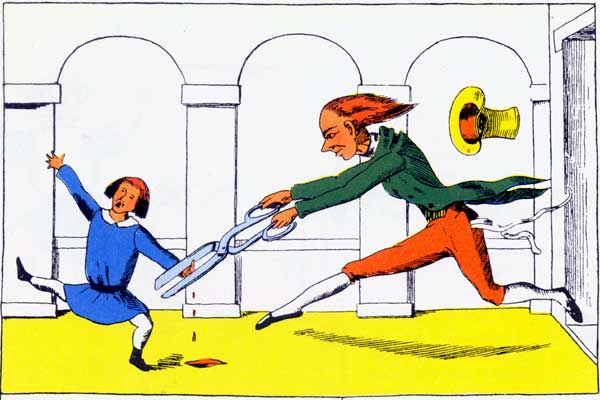
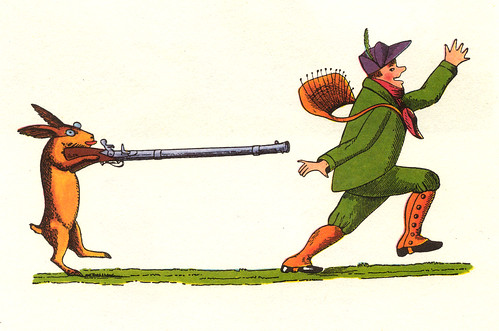
Cheer up, though, because nothing that happens to Joseph could possibly be as bad as the things the characters get subjected to in A Handful of Dust. I am coming to the conclusion that the inside of Evelyn Waugh's head must have looked like a series of illustrations from Struwwelpeter - it's not just that terrible things happen to his characters (which they do), but that the things that happen are astonishingly awful, with a sort of creative flair for nastiness that leaves you stunned. In one of his books (which shall remain nameless, so that you can still be surprised), a character actually and unironically is cooked and eaten by a cannibal tribe. In another, someone's head is sawn off to the accompaniment of loud song.

Somehow, this never gets into descriptions of Waugh's writing. Everyone pretends that he's all serious and sad and full of meditations on death and Catholicism, when ACTUALLY he's behaving like the Lord High Executioner, lopping off heads all over the place and then feeding them to people (note: I haven't come across this one yet, but I bet it happens somewhere).

One of the things I like about Evelyn Waugh is that he bothered to write about his contemporary culture. Sure, in his view, contemporary society has a great big hole in the middle of it, which everyone tries to fill in by having lots of nervous, meaningless conversations, but all the same I think Waugh understands that meaninglessness may be awful, but it can also be (secretly) quite a lot of fun. Anyway, I'm glad he included it, because I love hearing about the way a group of people lived, how they wasted time and got drunk and went to parties and so on. About halfway through A Handful of Dust it occured to me how very much these poor souls needed mobile phones. All of the characters in it seem to spend their entire lives crouching next to their home phones, ringing each other obsessively for lunch invitations and random relationship news. It's the ultimate proof that the invention of texting did not make anyone more inane than they were already. If these people knew the word lol, they would have used it extensively.

A Handful of Dust, apart from being about people talking on the phone a lot, is the story of the break-up of a marriage. Although I'm not going to spoil any of the gory details, suffice it to say that in Waugh's world, if you split up with your spouse things will not end well for you. I suspect it's the Catholicism coming out in, but oh my god, though, the things that happen to these poor people. They may be upper class twits, but no character outside of a war novel ought to be suffering quite as much as they do. Evelyn Waugh may very well have been an actual sadist.

And yet, like all his other books, A Handful of Dust really is funny - in a laughing-inside sort of way, that is. My dad gave me Decline and Fall when I was thirteen, with the promise that it was HILARIOUS. I think he might have got him confused with someone else. I read twenty pages, was horrified rather than amused and then gave up, because Evelyn Waugh is definitely not HILARIOUS. He's nasty. He's got a grim, dastardly sense of humour that you appreciate rather than chuckle at. You should seriously not give his books to thirteen year olds unless you want them put off The Classics for life, but reading him now I've come to like him.

I think.

In a disturbed sort of way.

3.5 stars

Friday, 22 July 2011

In which I make the case for Wilkie Collins (and also review No Name)

There's an assumption that a lot of people have that The Classics (by which they generally mean large books published before 1914, at which point war broke out, modernism was discovered and everything went very thin and meaningful) are boring. While I have to admit that this is not an entirely wrong assumption in specific cases - writers like Dickens were paid by the word, and it shows - it is most certainly not true at all times, and never less so than in the works of Wilkie Collins.

The Victorians liked their fiction COMPLEX, and most things produced in the latter half of the 19th century are mad long convoluted kitchen-sink soap operas full of marriage and surprise deaths and tragic blonde orphans. This is not a bad concept, necessarily, but it can drag, and trying to hold the complicated emotional issues of five families in your head at once does tend to unfairly tax your powers of memory.

Sensation fiction, however, which is the stuff that Wilkie Collins wrote (a breed of pre-crime-novel that was insanely popular in the 1860s and 70s - imagine it as the Scandinavian thriller of its day) solves this knotty problem by taking the general concept, trimming down the cast size, removing all the dull bits about toil and poverty and making sure that every single one of the many, many things that happen are INSANELY EXCITING. Murder! Wasting diseases! Divorce! Infidelity! Bigamy! Illegitimacy! Robbery! Infamy! Tragedy! Foreigners! (Note that the Tragedy usually comes from the Foreigners, who are always Evil. There is also a general tendency to Capitalise Random Words to show how very, very Sensational they are). The pure and unashamed point of sensation fiction is to be incredibly entertaining, via lots of delicious Dastardly Plots and Wicked Women and Vast Fortunes which are always In Danger from the (Foreign) Forces of Evil, and because of this Wilkie Collins's books are all insanely fun to read. They're also, helpfully, quite easy to get through - you don't have to struggle with ridiculous word choices or complex flights of fancy. Booker Prize hopefuls they are not, and they are all the better for it.

The most famous Wilkie Collins, and the one that you should definitely start with if you haven't come across him before, is The Woman in White. Its fabulous plot revolves around forced marriage but also manages to involve insanity, mistaken identity, an obsession with white dresses, a cunning murder plot and an Italian with a villainous love for small animals, and it features one of the greatest female characters to emerge from 19th century literature. Marion Halcombe has a keen journalistic instinct and a small and delightful moustache, and she could crush 99% of Dickens's heroines to death with the force of her mind. I've never been able to work out why Walter decides he wants to marry Marion's sister, rather than Marion herself - I would personally marry the hell out of Marion, moustache or no moustache. But then I suppose that I am not a Victorian man.

No Name, which Wilkie Collins wrote in 1862, straight after The Woman in White, has its fair share of forced marriage and mistaken identity too, but mainly revolves around illegitimacy and the rather insane Victorian laws on the subject. This was a topic that he clearly felt very strongly about, since his rather racy personal life meant that he had had quite a few not strictly legal children of his own. The basic plot of No Name is as follows.

After the unexpected death of their parents, the Vanstone sisters discover that they are illegitimate, and therefore under English law cannot inherit any of their considerable fortune. Despised and cast out (of course) by a cruel uncle, they must fend for themselves. This causes Norah (the boring one) to nobly go forth and become a governess, and Magdalen (the heroine) to completely lose her mind and decide to take her revenge on her wicked relatives by marrying as many of them as possible and taking them for all the dough she can. Her nemesis, as she tries to carry out her plans, is the Evil housekeeper employed by her Evil uncle. You can tell she is evil because a) she is Foreign, and b) she keeps a toad in a tank. Wilkie Collins was obviously very much against small pets, especially when owned by Foreigners.

Predictably, lots of lovely shenanigans ensue, with Magdalen trying to con her wicked relations, the evil housekeeper trying to con Magdalen and Norah  popping up well-meaningly from time to time to thwart all Magdalen's cunning plans by mistake. It's all very tense and exciting, and I can't imagine how Collins's original readers coped during the months and months it took to be serialised. I assume there were many people whose dying thoughts were along the lines of "I may be leaving my wife and child destitute and forced to choose between starvation and prostitution, but at least THEY'LL get to find out how No Name finishes. Damn those lucky sods."

It all, actually, peters out into a rather piddly and saccharine ending (I really don't think I'm spoiling anything much if I tell you that Good Ultimately Triumphs), but I enjoyed the whole thing up until that point so much that I tend to forgive it its conclusion. After all, it wouldn't be a proper Victorian novel without a bit of ridiculous sentimentality and a fainting fit or two.  

No Name gets a solid 3.5 stars.

In conclusion, sensation fiction is really bloody good, and I think that everyone should read much more of it. Don't expect it to blow your mind with its truthful portrayal of the human condition, and do expect there to be moments where you stop, put down the book and think, well, that's bloody stupid, but definitely do expect to have a good time. Because you will.