Showing posts with label tallis. Show all posts

Sunday, 4 November 2012

Review: The Forbidden

Frank Tallis tends to write crime novels, of which my boyfriend and I are huge fans. His Liebermann series, set in Freud's turn-of-the-century Vienna, is a highly comforting mixture of cake and death in which 99% of the scenes proceed in the following manner:

"We have just discovered the body of a prostitute with her stomach ripped out lying on the steps of the Opera House!" said Inspector Reinhardt in his distinctive baritone voice.

"That is terrrible!" said his friend and ally Doctor Liebermann. "In my expert opinion, you are looking for a killer with mother issues and an oral fixation."

"What deduction, my friend!" Reinhardt's stomach rumbled and he chuckled musically. "All this thinking has made me hungry. Shall we repair to Demels for some Palatschinken?"

"An excellent idea!" cried Liebermann.

Both men thought of the sweet, spicy pancake parcels, with scented vanilla cream and tender apricot jam oozing from their delicate golden folds in a way that was almost erotic. Reinhardt licked his lips eagerly. "Come along, my friend!" he cried. "That eviscerated prostitute can wait."

There is so much cake in the Liebermann novels that you can put on six pounds just by thinking about them.

Anyway, they're pretty great, but pretty silly, so it's not entirely surprising that Tallis has decided to try his hand at something a bit darker. Writing as F. R. Tallis (not a supremely cunning pseudonym as they go, I rumbled him immediately) he is now reinventing himself as a horror writer, and his first novel in his new genre is The Forbidden.

The Forbidden is a tale of supernatural possession that moves from voodoo on the island of Saint-Sebastien to the depths of nineteenth century Paris, a Paris where Charcot 'cures' hysterics in Salpetriere, doctors investigate electrical resuscitation and the possibility of life after death, dissolute prostitutes shoot up every night and Notre Dame cathedral is a portal into Hell.

Remember I mentioned Tallis's penchant for eviscerated prostitutes? Well, it's clear he's been keeping the full extent of his interest in the subject under wraps until now. The Forbidden pulsates with flayed women, oozing blood from all manner of unpleasant incisions. I had extremely uncomfortable moments while reading it, and though I assume that Tallis just enjoys horror and all its trappings conceptually, the way I love murder (Tallis is a clinical psychologist, after all, so he's probably had access to a lot of dark ramblings from which to draw his material), this is certainly not a book for the faint-hearted or weak-stomached.

I do think, oddly enough, that Tallis is displaying a more controlled and objectively better writing style in this dramatically-themed book than he ever has before. Gone are the odd over-descriptions that the Liebermann novels are so full of (tears becoming dilutions of sodium choloride and so on). What's left is vivid but simple prose that manages to evoke his highly-coloured material well. Unfortunately, though, what he's writing about, although undeniably a lot of (extremely twisted) fun, isn't as unique as the Liebermann mysteries. In fact, it's pretty much a mash-up of every supernatural horror film and book ever written. Island voodoo? Check. Fin-de-siecle French depravity, complete with crack and whores? Check. Priests battling satanic forces with bell, book and candle? Check. Youthful virgins spewing profanities and bodily fluids while their heads spin round like manic owls? Check.

There is a basic story running through it all (overreaching young doctor goes to hell and brings back an ancient evil which he must then exorcise) but the plot still feels bitty, broken up into sections that don't seem to bear much of a relation to each other. You can tell, for example, where the Huysmans bit ends and The Exorcist begins. In fact, the different parts of the book could almost be read as a series of linked short stories - but they're being presented as a single narrative, and that's the book's biggest problem. Tallis tells us in an end-note that The Forbidden is a homage to a lot of his major horror influences, which is great for fans of the genre, but at times I felt like the balance between affectionate recycling and innovation was a little off.

To call The Forbidden good fun would be... a bit creepy of me. But I did like it (though sometimes in a disturbed sort of way). It isn't innovative, but it's exuberant and skin-crawlingly dark, and as a first foray into the genre by someone who is obviously a long-time fan, I think fellow horror buffs will find it enjoyable.

Tallis's next outing (The Sleep Room, published by Macmillan in 2013) looks like it will benefit from a tighter focus, and I'm looking forward to it a lot. There's a big part of me, though, that misses the comfort of those Viennese cakes.

3 stars.

Friday, 30 September 2011

Cooking the Books: Frank Tallis

When I started this blog I thought half of it was going to be about baking. It turns out, though, that whenever I bake something I always just end up eating it before I remember to take pictures. This is obviously not good enough, and so I have come to a decision. This decision is that whenever I read a book with really exciting food in it I am going, in the spirit of research, to make that food. And I am going to blog about it.

The rules of the game are as follows:

1) The foodstuff must, obviously, appear in the book in question.
2) it must be mentioned by name.
3) Preferably it should be described in some way.
4) Bonus points if the description is sexually delicious.
5) I really do have to take pictures of it. Google images will not do.

The first food-centric book on my list is Death and the Maiden, by erotic pastry writer extraordinaire Frank Tallis. I've written before about Frank Tallis's probably very Freudian relationship with cake, and also about how reading his books makes me want to go bury my face in the front window of a Patisserie Valerie.  

Death and the Maiden, it turns out, is not as sugar-laced as Frank Tallis's previous efforts (I felt somewhat cheated - I want cake with my death!) However, cake still gets mentioned by name nine times (that's not counting savoury foods or all the times the characters are just 'eating pastries'), so the foodstuffs I get to choose from for my first experiment are: Guglhupf, Mohnstrudel, Topfenstrudel, Apfelstrudel, Palatschinken, Mannerschnitten biscuits, Sachertorte, Marillenknodel and Vanillestern biscuits. Of these, Mannerschnitten turn out to be wafers that come in plastic packets, Marillen are apricots, which are not in season, Schinken are pancakes, which are not very inspiring, Mohn means poppy seed, which is not exciting either, Apfelstrudel we all know far too well anyway and I had Sachertorte in the actual Hotel Sacher last year and thought it was disgusting.

So I went with the Guglhupf. It is described in Death and the Maiden, with masterful brevity, as
a sponge slice, sprinkled with icing sugar
Which is perfectly delicious sounding, but not particularly helpful to someone actually trying to cook it.

Now, I've been fascinated by Guglhupf for quite a while. It keeps coming up in Austrian-themed books, quite mysteriously. No one seems to ever quite be able to describe what it is, although it is unanimously seen as A Good Thing. It turns out, once I began to scan Google for recipes for it, that no one on the internet can agree on the recipe for it either. Sometimes it has chocolate in it, sometimes it doesn't, sometimes it has orange juice and raisins and rum, often (but not always) it has almonds, sometimes it is made with icing sugar and, most interestingly, sometimes the recipe calls for yeast. This, I think, is the important thing, since when I went onto Wikipedia in desperation I discovered that -hupf means jump. A jumping cake! I like it.

In the end I went with a recipe without chocolate (since I think that would be Schokoguglhupf and slightly different) and with yeast: basically, this one from Food.com but without the almonds (I hate almonds) and with more sugar (Guglhupf can be savoury sometimes, and that is fine for other people but very definitely Not What I Was Going For). Yes, it's in American, but proper cup measures are fairly easy to find in England these days and if you don't have those there's always the miracle of Google.

So, in the name of Science, here's my modified Guglhupf recipe.

The romantic ideal
Yeasty part
1/2 cup milk
2 1/2 teaspoons active dry yeast
2/3 cup unbleached all-purpose flour

Cake part
1/2 cup raisins
1 tablespoon dark rum
6 tablespoons unsalted butter, softened
6 tbsp sugar
1/2 teaspoon salt
2 teaspoons grated lemon zest
1 teaspoon vanilla extract
2 large egg yolks
1 1/3 cups unbleached all-purpose flour 

BUTTER
Heavily butter a Guglhupf tin, or a Bundt tin (which is what I have), or any other sort of round and holey cake tin you fancy.

Heat the milk in a saucepan until it is lukewarm. This took an astonishingly short time - I ended up overheating it and then having to wait for it to cool down. Basically, ten seconds will do it. Pour the milk into a bowl, add the yeast (2 1/2 teaspoons turns out to be one of those little Hovis fast-action packets, so save time and just chuck the contents of one of those in), stir it about and add the flour. Cover with clingfilm and leave in a warm place.
Rum raisins. Excellent.

MEANWHILE! Add the rum to the raisins in a bowl and let them sit. I'll be honest, I added more than a tbsp of rum - it seemed somewhat stingy. I like rum.

Watch 20 minutes of Celebrity Masterchef. Return.

Fluffy yeasty bit. With lemon.
For the ordinary cakey bit, cream together butter, sugar (90g of each, if you don't have a US tablespoon) and salt, then add the vanilla and the lemon zest. Beat in the egg yolks one at a time, THEN add your puffed-up yeasty mixture. The original recipe is so bloody vague about the difference between 'dough' and 'sponge' that I did not notice this direction and just went straight ahead and added the rum and other flour. So don't be like me. Add the yeast stuff, mix; sieve the rum out of the raisins (leave the raisins out for later) and add that, mix; add the rest of the flour, mix; let the mixture sit.

Watch 10 minutes of Celebrity Masterchef. Return.

Dough. Buttered.
Beat the dough a bit more, until it's smooth and elastic (I think what you're doing here is equivalent to kneading) and then beat in the raisins (and almonds, if you're using them). At this stage the batter tastes somewhat like Stollen, that is, nice and yet odd.

At this point, the recipe says  
Scrape the dough into a buttered bowl and turn it over so that the top is buttered. 
I find this direction confusing, mainly because it seems so deeply unnecessary and also makes me have to wash up another bowl. I did do it, but I suspect the cake would be OK without it. Now cover this new bowl of yours with cling film and leave it in a warm place to rise again. (There is a lot of rising in this recipe. Definitely not one for the temporally challenged.)

NOT RISING
Do 20 minutes critical reading that you should have done before you watched Celebrity Masterchef but you didn't want to. Return.

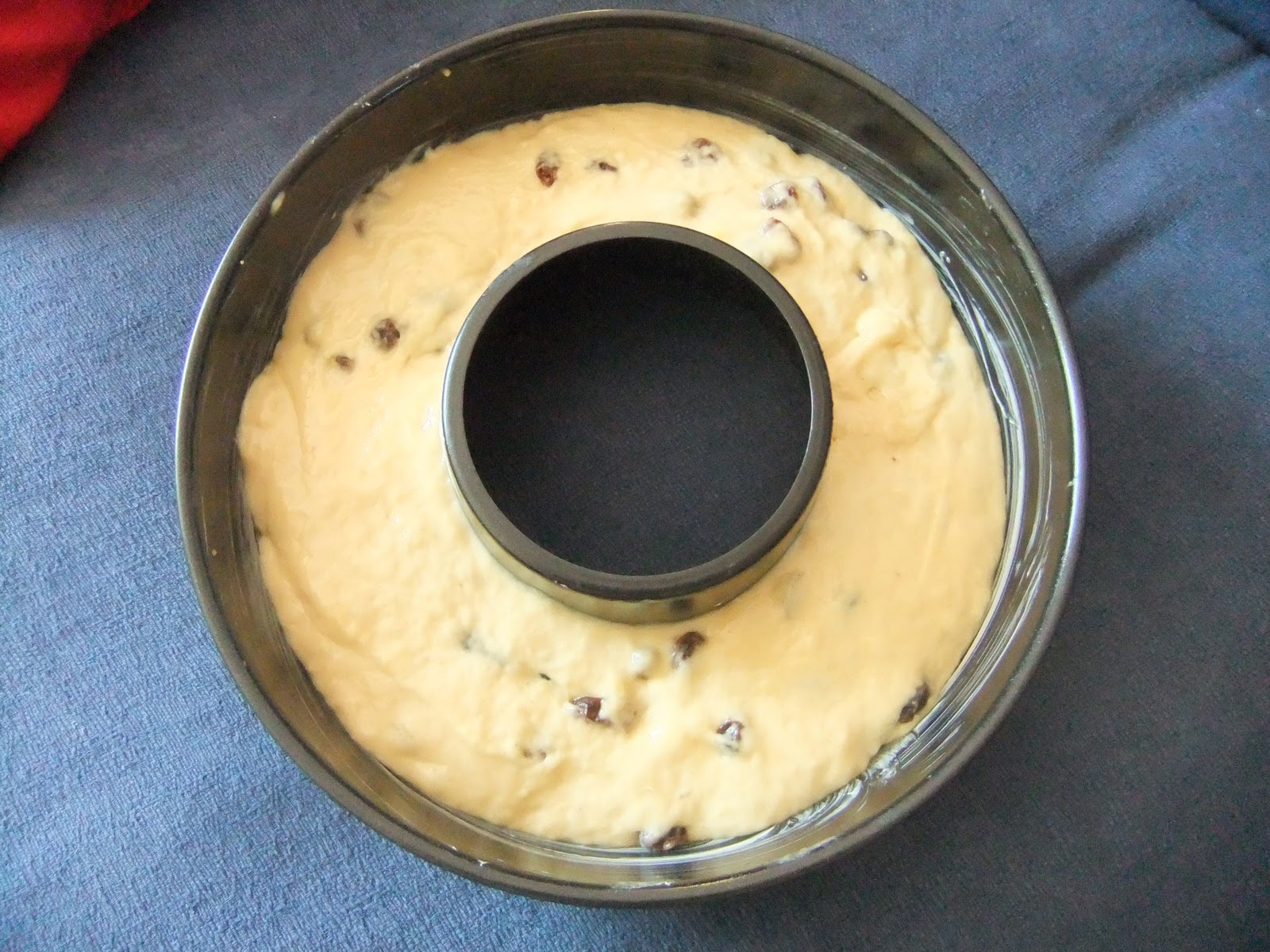
Scrape your batter into your mightily buttered cake tin, then cover with a tea towel or some buttered (!) cling film (what is it with this author and buttering things?). Then leave in a warm place 'until it is doubled'. The recipe helpfully makes no mention of how long this should take, and 30 minutes after I first left it IT HAD NOT RISEN AT ALL. I got so desperate that I put it on my desk so it could get the sun. Unfortunately this did not seem to do anything for it.

Ready to be ovened.
After 45 minutes I got bored and annoyed and just turned on the oven to 190 C (or 170 C for a fan oven) to preheat. Fifteen minutes later, I put in my stubbornly un-hupfy Guglhupf and left it to bake it until 'well risen and deep golden' - the recipe says about 40-45 minutes but it took my oven 30. This may have had something to do with the lack of rising beforehand. (Pro tip for cake doneness measuring: Stick a fork into it and if its prongs come out clean you're there.)

Out of the oven.
Take it out and leave to cool for ten minutes, then flip over and get it out of the tin. GENTLY. Leave to cool the rest of the way and then sprinkle with icing sugar for fancy effect.

And there you have your Guglhupf.

I'm sure it was because I abused the yeast in some unknowable way, but I am a bit sad at how very un-hupfy my Gugl turned out. It seems to make the time I spent sitting about waiting for it to rise slightly futile, in retrospect. This Schokoguglhupf recipe seems much more achievable (whipped egg whites instead of yeast) and I may try it for contrast some time.

The not entirely romantic reality
But then I took the finished cake to dinner at a friend's house, and it actually turned out to be very nice. It definitely did have a bready Stollen sort of thing going on - buttery lemony raisiny goodness with that nice tangy kick that booze leaves behind when it cooks. As one of my friends pointed out, it would be especially excellent at Christmas time (she also suggested adding a few plastic reindeer and Father Christmases around the top but I think this would be down to personal taste). I admit that it was a bit heavy - you could probably hurl it at someone and do them a fair injury - but this is because of my mistake rather than any fault of the poor recipe's.

Anyway, a tasty if slightly perplexing recipe, and one that convinces me more than ever that Austrian baking is Where It Is At. And now this book is most definitely on my Christmas wish list. (I bet Frank Tallis would like it too. You know, in case you were trying to find a present for him. Which you might be. I don't know your lives.)

Tuesday, 13 September 2011

Review - Darkness Rising

So, the Booker Prize shortlist for this year has been announced. And there it is. It's a shortlist. Unmistakably a list, and a short one at that.

Goodness.

I'm really struggling to muster any emotion about this one. I feel... whelmed. Distinctly whelmed (because I am in Europe, and I can be). The Sisters Brothers has the best cover, and Sense of an Ending is, er, the thinnest (can you tell I haven't read any of these, or really been moved to?). If I had to pick a winner, though, I'd go for Pigeon English, since it's the only title that seemed to be generating any sort of low-level person-to-person buzz before it was nominated. I mean, I worked in a fairly literary, well-read bookshop for most of this year and I don't think I even sold a copy of any of the rest of them. I'm going to try to read some of them, and we shall see, but... hmm.

Anyway, review.

I spent most of last Wednesday sitting in a hospital waiting room. Which turned out very well for all concerned, so don't worry, but at the time was not exactly restful. We happened to be sitting next to a woman who kept calling people up and saying awful things like, "and then his lung collapsed, and then his OTHER lung collapsed, and then he lost sensation in his legs, and then his SPLEEN burst," while her child ran around in circles screaming "MUM I'm BORED I'm SICK THERE'S A STICKER MISSING FROM MY COLOURING BOOK!"

I had sort of guessed it might not be a place for my MA reading, and so I brought along a book that would be exceedingly restful. And then I read the whole thing. That day had a lot of time in it. I think they might have been slowing down the clocks. But Darkness Rising kept me calm, because there are two things that soothe me more than anything else in the world and those things are CAKES and MURDER. And that is all Frank Tallis's books are ever about.

There is an amazing amount of pastry in a Frank Tallis murder mystery. His excuse, I think, is that they are set in Vienna, where cake is a form of religion (I have been there. I know. French pastry wishes it was that delicious), but even so, his characters' relationship to pudding borders on the obsessional. You could make a very profitable Frank-Tallis-spot-the-foodstuff drinking game, and the last time my boyfriend read one I got a stream of delighted texts all along the lines of CAKE! CAKE SPOTTED IN CHAPTER FOURTEEN!

And this is not just any cake, either. These cakes all have mysterious and delicious names, like guglhupf and punschkrapfen, and whenever a character bites into one you are treated to an intricate and borderline erotic description of the taste sensations they are experiencing:
At once his mouth was suffused with a melee of flavours. The coolness of the shell contrasted with the warmth of the alcoholic sponge inside, and he was overwhelmed by an almost dizzying sweetness. After he had swallowed, his taste buds were still tingling with flavours: marzipan, nuts and jam.
I mean. Take off all your clothes, Frank Tallis is writing about food again.

Frank Tallis's background is nearly as bizarre as Anne Holt's. He's a practicing clinical psychologist who happens to write historical murder mysteries on the side - and, of course, because he's a clinical psychologist his chosen bit of history is Vienna at the turn of the last century, when Freud was getting everyone het up about children sucking their thumbs and people dreaming about wolves in a wardrobe. His main character, Dr Max Liebermann, is a disciple of Freud, and all the murders he investigates are conveniently to do with unconscious desires and sex mania. We also get treated to hilarious b-plot side cases as Dr Liebermann treats his patients - in Darkness Rising, for example, we get the case of a man who thinks he's pregnant. Which is totally brilliant.

What Frank Tallis is not, though, is a technically excellent writer. His policy seems to be that he knows a lot of words, and by god he is going to use all of them. People aren't unconscious, they're insensate, a carving of bears becomes eponymous ursine relief work, and image of someone's boobs in a low-cut dress is described as
She was wearing a tight silk dress, the intrepid neckline of which descended steeply, revealing a plenitude of bulging flesh.
You guys, she was stacked.

But all the same, it's not the sort of language-abusing writing that makes me want to tear out my hair in a rage. It's just gently silly, and the result is an awful lot of fun.

Darkness Rising's plot, such as it is, concerns a series of mysterious murders of notable anti-Semites, who all turn up beneath plague monuments with their heads ripped off. If you know your Jewish folklore you're going to get to the answer quite a bit before Liebermann and his policeman sidekick Inspector Rheinhardt do, but the point of this book is not cunning trickery. The point of this book is cakes and psychoanalysis. And the cakes are good.

I nearly forgot I was in a hospital waiting room.

3.5 stars.