Showing posts with label james. Show all posts

Saturday, 8 September 2012

1001 Books Review: The Master

No matter how hard I try, all the books I write turn out to be about people saving the world. One time I tried to write a gentle romance where nothing happened and a) it was terrible and b) they ended up saving the world anyway. Therefore, I am consumed with admiration for authors who manage to make plots about characters just wandering around houses and talking to each other seem elegant and interesting.

I don't mean those books that do not feature the invasion of giant rats from Mars or werewolves or decapitated heads in pies or something, like the novels of Dickens or Byatt or Ali Smith, I mean books in which the entire point is that literally nothing happens. The plot is that there is no plot, just some dude walking about and thinking.

Where do all the words come from? How do you keep going when you know that nowhere in the 100,000 words you have yet to write does anybody blow up a power plant or transform into a dragon? Don't get me wrong, I love reading that kind of book, but the thought of writing one makes my brain short-circuit. Evidently, though, there are lots of writers out there who have no idea why anyone would ever write about werewolves, and since those are the writers who win the Booker prize I guess I should envy them even more than I already do.

Just such a writer is Colm Toibin (which I learnt today is pronounced Collum Toebean, you can thank me later unless you are Irish and knew that anyway), and just such a text is his novel The Master.

Not this one
No, Doctor Who lovers, not that Master. The Henry James kind of Master. I'm not sure if that's a nickname all the cool academics use, or if Toibin just made it up to convey the idea that James wrote a lot of masterpieces, but the point is that this book is about the later life of Henry James, as he travelled around Europe gathering plot ideas for his novels while failing to have meaningful life experiences or form emotional connections with other human beings.

This one
Toibin's James is a man chronically afraid of feelings. He watches other people being bereaved, or falling in love, or struggling with depression, and sucks it all up into his head to use in his books. He refuses to actually vocalise or act on any of his own emotions - instead, he hides them in his novels in the fond and mistaken belief that no one will realise he's writing about himself.

There's a story that gets told repeatedly in The Master. In his younger days, in Paris, James once stood all night outside the home of a man he fancied, just glaring up at his window and getting rained on because he couldn't bear to actually go on in and try his luck. That's pretty much the pattern of the life of Toibin's James. He makes eyes at men but fails to sleep with them; he makes friends with women but fails to invite them to stay with him (after which the women die and James suffers hidden inner tragedy).

It's all written in a very peaceful, detached way, like looking at the reflections of buildings in water rather than the buildings themselves. There's a sense of unacknowledged things lurking in the depths that make the surface calm seem a little bit creepy - which is completely genius on the part of Toibin, because that's precisely how it feels to read one of James' stories. The one everyone knows, of course, is The Turn of the Screw, which you should ABSOLUTELY READ THIS MOMENT if you haven't already (that is how strongly I feel about how brain-wigglingly brilliant it is), but I had to read 'The Beast in the Jungle' for an MA module last year and it has exactly the tone that Toibin has captured in The Master. In 'The Beast in the Jungle', two people are waiting for something creepy to happen, nothing happens, nothing happens and then it turns out that the creepy thing they have been waiting for is... nothing. And yet it is still creepy. 'The Beast in the Jungle' is (probably) about being gay, which is (probably) what Toibin's novel is about too, but like everything to do with James, you can never quite be sure.

In The Master, Toibin has pulled off something pretty special. It's a well-researched, interesting and pitch-perfect homage to James' fiction, a book about James that could almost have been by James. For a book in which literally nothing happens, it's amazingly compelling, and (the test of a good piece of writing about an author) I came away wanting to read a lot more of James' novels. On balance, I probably prefer to read about werewolves and decapitated heads, but if you want a bit of elegant nothingness in your fiction, Toibin - and by extension James - is a very good way to go. Yes, nothing happens in a Henry James novel or in The Master, but it doesn't happen in a really interesting way.

4 stars, and 20.68% of my 1001 List finished.

Monday, 23 July 2012

Review: No Orchids For Miss Blandish

Sometimes it seems like George Orwell has written an essay about EVERYTHING. Elephants? Check. Pubs? Check. Anti-Semitism? A rather temporally impressive check. Orwell is an extremely lucid and literate resource for anyone seeking a reasonable opinion on anything - although he does tend to have an automatic and amusing assumption that anything new is probably going to be WORSE THAN THE OLD THING WAS. He is a filthy cynic and I like that about him.

He is particularly crusty about my specialist subject, murder. Not only, according to Orwell, is the quality of real murder declining awfully, but murder mysteries these days (read: the forties) are simply not what they used to be when those bad old Victorians were in charge of the written word. One of the first essays I ever read by Orwell, 'Raffles and Miss Blandish' is about just that - a comparison of late-Victorian and mid-twentieth century attitudes to crime and criminality in literature. The two books he uses are smartly chosen to make his point (which is essentially: we are awful, they were great): representing the Victorians is the estimable Raffles, and holding up the side for the twentieth century is a book published in 1939 called No Orchids for Miss Blandish.

Miss Blandish is... an interesting book. I'm going to stop here and give you Orwell's own summary of its plot, because, as I think you'll see, it'd be hard to beat (hah).

Miss Blandish, the daughter of a millionaire, is kidnapped by some gangsters who are almost immediately surprised and killed off by a larger and better organized gang. They hold her to ransom and extract half a million dollars from her father. Their original plan had been to kill her as soon as the ransom-money was received, but a chance keeps her alive. One of the gang is a young man named Slim, whose sole pleasure in life consists in driving knives into other people's bellies. In childhood he has graduated by cutting up living animals with a pair of rusty scissors. Slim is sexually impotent, but takes a kind of fancy to Miss Blandish. Slim's mother, who is the real brains of the gang, sees in this the chance of curing Slim's impotence, and decides to keep Miss Blandish in custody till Slim shall have succeeded in raping her. After many efforts and much persuasion, including the flogging of Miss Blandish with a length of rubber hosepipe, the rape is achieved. Meanwhile Miss Blandish's father has hired a private detective, and by means of bribery and torture the detective and the police manage to round up and exterminate the whole gang. Slim escapes with Miss Blandish and is killed after a final rape, and the detective prepares to restore Miss Blandish to her family. By this time, however, she has developed such a taste for Slim's caresses that she feels unable to live without him, and she jumps, out of the window of a sky-scraper.

Now, Orwell does not rationally approve of Miss Blandish. Reading it, he says, is like taking 'a header into the cesspool'. This is not, oddly enough, because it is badly written (according to him, it is 'a brilliant piece of writing, with hardly a wasted word or a jarring note anywhere'), but because its glorification of violence reminds him uncomfortably of the nationalist cults of Mussolini and Hitler. It's a bad sign of some bad times - but all the same, Orwell can't quite bring himself to pan it.

Given the fascinating awfulness of that plot summary, and the fact that Orwell clearly can't decide whether he loves it or loathes it, I've been curious about Miss Blandish since I first read the essay. Unfortunately for me, it's been pretty conclusively out of print for years. But then my excellent friend Boadicea, who has never met a literary problem she could not solve, walked into a second hand bookshop and discovered a bright-red and battered copy of No Orchids for Miss Blandish glowing up at her like a nightmare prostitute sign. So she bought it. And now I have read it. And, ladies and gentleman, I can conclusively reveal to you all that

IT WAS AWFUL.

Hesistant as I am to call Orwell wrong, he must, in this instance, have been huffing some fairly strong substances. Miss Blandish is about as far from 'a brilliant piece of writing' as anything I've read all year. It is the verbal equivalent of those drawings by very small children, where the sky is a purple line, the house is bright green and Mummy and Daddy are alien blob-circles being given electric shocks to the head. Blandish's narrative is about as focused as a fly with ADHD, its point of view changes with dizzying irregularity, and its descriptions are bewildering. Its slang (of which there is a lot) is also simply weird: for example, people 'dig up a smile' (from where? From the ground?) more times than I would have ever thought possible. The general effect is that James Hadley Chase has taken all the most famous noir crime tropes he could think of, dialled them up to eleven and stuck them in a blender.

Now, I believe firmly that it's possible to read an older book that's horrifically racist or sexist by today's standards and still enjoy the other aspects of it. For example, I may despise and be offended by Raymond Chandler's penchant for having his characters casually beat up women and Mexicans, but I have to admit that he's an incredibly technically accomplished writer. But there has to be something in that book worth admiring, and I am not about to begin being an apologist for a racist and sexist book with absolutely no redeeming features whatsoever. Therefore I have no problem at all with saying that Miss Blandish should NEVER BE READ AGAIN. By all means, keep a copy of it somewhere as a reference point for a time that we don't ever want to go back to, but please, please, don't ever give this book a reissue.

Its crimes against decent humanity are many. At one point, for example, the 'hero' (who is a watered-down Philip Marlowe with no inner life and fists like angry hams) decides he needs to question a Hispanic character. He therefore walks into the room and, with no word of warning, breaks the guy's nose, blacks his eyes and lays him out on the floor. And then he starts questioning him. Some of the novel's ladies were watching this exchange, and they totally adored what a manly man the hero was being. Women in Miss Blandish truly dig violence, which is lucky, because there isn't a scene a woman appears in where she's not at least slapped and at most threatened by red-hot electric wiring. Whenever a woman happens to express an opinion that isn't 'I want to have sex with you now!' all the men in the room look at each other like they can't believe the dishwasher just spoke, and I cannot even begin to tell you how many times rape is presented as a delightful bit of gentlemanly fun.
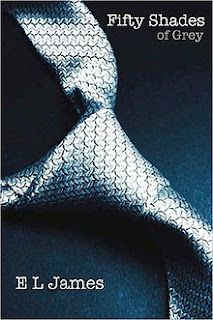
Oh god, I hated this book. It was brainless, pointless and poisonous - and yet, as I was reading it, I realised that I understood exactly what it was: 1939's answer to Fifty Shades of Grey.

One of the more amusing aspects of the recent wild media explosion about E. L. James and her tasteful tale about being whipped in the nether regions in the name of true love is that many commenters appear to think that this is the first time the nation has ever been gripped by a craze for a trashy book. Their brains appear to have been mercifully wiped of all memory of Twilight and The Da Vinci Code, for which I am profoundly jealous. But it's becoming pretty clear to me that every few years a really badly written book comes along that is totally and utterly tuned in to what people want at that moment.

What people want now, apparently, is aspirational pain porn featuring a City billionaire (this actually makes sense, given the recession: the world hates rich people, but loves money, creating vast ambivalence and the perfect sexual enigma), and it seems like what they wanted in 1939 was really, really nasty noir porn featuring a rich woman getting her comeuppance for being so rich and female. That's a pretty vile concept, but so's our Hot Thing of 2012, which just goes to show that people will never cease to disappoint you.

Like so many of the people commenting on Fifty Shades today, I suspect Orwell fell victim to Book Apologist Syndrome. Being of the time, he read it and got something from it, and so tried to justify his guilty pleasure by discovering that is was actually a literary masterpiece. Of course, this doesn't hide the fact that in reality the thing is a turd, but looking at it in this way makes me finally understand why Orwell wrote about it at all, and why he responded to it the way he did.

Miss Blandish clearly was the subject of the most enormous craze - the edition I read claims amusingly that 'The story of Miss Blandish needs no introduction... She has been accepted as a household word'. Of course, this is entirely no longer true, and this suggests to me the delightful possiblity that in fifty years' time no one will have heard of Anastasia and Mr Grey - or Bella and Edward - either. Won't that be nice?

Meanwhile, though, it is time for the rating. I am not from 1939, and so I have no hesistation about making this the first book ever on this blog to be awarded

1 star.

Thursday, 19 April 2012

Two super-speedy reviews while I am supposed to be writing my essays

So, the essays are going well, as is the internship. I was let out on day release to go to the London Book Fair on Monday, at which I felt very junior and unimportant (who knew there were so many men in publishing? Where do they hide for the rest of the year?), but I did wander past the Hachette booth, which, in honour of The Casual Vacancy, had a GIANT POSTER of J K Rowling's face staring down at passers-by like a benevolent dictator and/ or a mid-level deity.

This made me quite suspicious, probably because I just finished reading Wild Swans by Jung Chang and now I am seeing cults of the leader everywhere (including in North Korea, but that's not just me).

Wild Swans is one of the only non-fiction titles on the 1001 books list, a biography/autobiography combo about three generations of Chinese women who collectively lived through the Japanese occupation of Manchuria, World War II, the rise of Communism and the increasingly crazy machinations of Chairman Mao. Their historical CVs are amazing - Chang's grandmother was one of the last warlord concubines (a dubious honour), Chang's mother was one of the first Communist party sympathisers after World War II and her father was a high-up party official who governed a couple of provinces. As you do.

I have to say, Wild Swans isn't particularly well written - most of the time, it's perfectly functional, but sometimes she lapses into a badly-done contemplations of the beauty of the universe and the result is just tiresome. But it's a bestseller not because of the way it's written but because of what it's written about. It's an incredible (and totally terrifying) inside record of what went wrong with Chinese communism and why.

Before I read Wild Swans I had only vague background knowledge about recent Chinese history, so I sort of knew that the Great Leap Forward and the Cultural Revolution had happened, and were Bad Things. Well, now I know the details, and it turns out that Bad doesn't even begin to cover it. At one point, for example, Mao decided that China should make more steel, so he got everyone in the entire country (including children - as a six year old, Chang had to pick up scrap metal on the way to school) to stop what they were doing and obsessively make steel, with the result that the crops failed and millions of people just died of starvation. And everyone had been so indoctrinated by Mao that they honestly believed it was all for the best.

The number of people who are tortured and killed in this book is staggering, as is the number who just committed suicide out of sheer shame and horror at what was going on. At times I actually felt like I was reading a dystopian sci fi novel - the mind control, the street gangs, kids beating up their teachers, families forced to live separately and so on. It's almost unbelievable to me that what she's writing is - or very recently was - all true. (On that note, the writer part of me thinks that if you are considering publishing your own dystopian novel, Wild Swans is a must-read background text. You don't even have to make this stuff up.)

My only warning is that if you want to be at all surprised by the fate of Chang's family DO NOT FLIP TO THE PICTURES in the middle of the book, because you will be horribly spoiled by captions like 'The last picture of Blah Blah, who died unexpectedly in 1949'. I did, and I was, and I was cross.

Long as it is (and I admit, it is somewhat over-long), it's absolutely worth a read. Mind-blowing and extremely eye-opening, both from a historical and a human-nature point of view, it's everything you never knew about Communist China and didn't think to ask because it didn't occur to you that human beings could possibly do those kinds of thing to each other in the real world.

3 stars.


After all that heartbreaking suicide, I wanted some more light-hearted death (I typed that sentence and realised what an awful person I am, but there's no other way to say it), and so I moved on to P D James's The Murder Room.

I'm always on the fence about James as a writer. On the one hand, she's a good mystery writer, she makes up interesting cases and her detective is, you know, a perfectly fine individual - but on the other, she is the most gloomy person in the world. I grew up on Agatha Christie and Ngaio Marsh, so I have a baseline assumption that written murder should be jolly, a nice minty after-dinner puzzle with body parts for effect. It's a point of view I think crime writers are coming back to more and more these days, but there was obviously a time in the 70s and 80s, when James was forming herself as an author, when everyone was reacting against silliness and trying to show how very serious the business of death really is, etc etc.

As a result, everyone in a P D James book runs around tiresomely contemplating THE YAWNING HOLE AT THE CENTRE OF THE UNIVERSE and their INABILITY TO BE HAPPY. It gives me a stress headache. Yes, yes, the world is very terrible, but it's also quite funny and stupid, and there's no acknowledgement of that in a James mystery. Every single one of her characters feels alienated and unfulfilled and has family who are awful and they hate. One or two such people might be understandable, but an entire book full of them leads me to believe that something Freudian is going on. I'm willing to bet the James family is not a barrel of laughs at Christmas time.

Because of all this, I never end up enjoying a P D James as much as I really should, given the ingredients involved. The Murder Room is all about someone copycatting 1930s murders (James, like me, is clearly the most enormous historical murders geek), it takes place in a museum and a girls' school, and it's a murder mystery. All my favourite things! And yet, at its heart it's joyless and a bit functional. The most interesting bits for me were (unsurprisingly) the descriptions of the original '30s murders. They made me want to ring James up and talk to her about my dissertation, which happens to be about real Victorian murders and their influence on 1930s crime novels. I think we'd get on better through the medium of fact than we do with fiction - no coincidence that my favourite James book is her true-crime recreation of the Ratcliff Highway Murders, The Maul and the Pear Tree.

But anyway, The Murder Room was fine. Acceptable. Functional. It passed the time. And it made me crave a nice bit of Agatha Christie. Now there's a woman who knows what to do with murder.

2.5 stars.

Friday, 10 June 2011

In which I realise I am old; also Review - The Map of Time

 So. Tea Obreht won the Orange Prize the other day. Tea Obreht is 25. I am 23. What have I done with my life. If I haven't won the Booker by next year I will be the literary equivalent of an old maid. Tears, recriminations, Mr Collins etc await me.

As a bookseller, I am similarly unhappy. Tea Obreht's publishers, amusingly enough, noticed that the Orange Prize would be announced on the 8th and decided not to print The Tiger's Wife in paperback until the 13th, so we have no copies in the store and no way of getting them. If I had taken the precaution of painting WE HAVE NO TIGER'S WIFE HERE, COME BACK NEXT WEEK on my forehead this morning, today would have been about 75% easier to handle.

But anyway, onto today's book review, which has nothing in common with The Tiger's Wife at all, since it is mainly concerned with time travel, H G Wells and giant robots from the future.

The Map of Time, in proof copy form, has been sitting on my floor since, I think, February, just languishing away at the bottom of my to-read pile. Every time I got to the point of picking it up, I ended up being repulsed, and if you look directly left you will see why.

This, I think you'll have to agree, is an utter turd of a front cover, simultaneously evocative of Twilight, a wasting disease and MS Paint. It is vomitous. I kept hoping that the actual book would miraculously not look like this, but the trade paperbacks came into the shop yesterday, and alas, they look just as bad as my proof. I can't even imagine which market the publishers thought they were going to reach out to with this - people who cannot see? The deranged? People who wished that Twilight was more robotic than it already is?

So anyway, although chronically repulsed by the cover, I finally decided to read the first chapter to check if it really was as bad as it looked - and the first chapter turned out to be all about a young aristocrat, tragically in love with Jack the Ripper's final victim. Ahah! I thought. This IS terrible! This is incredibly stupid! This writing is totally clunky! I'll just read one more chapter to make sure it keeps on being ridiculous, and then I'll stop.

And then I finished the book.